Visualizzazione post con etichetta erbari urbani. Mostra tutti i post

lunedì 4 luglio 2011

NEXT STOP: Bovisa | I progetti realizzati

NEXT STOP: Bovisa
Milano e Oltre. Creatività giovanile verso nuove ecologie urbane
17 giugno 2011 – Quartiere Bovisa


Ecco alcune immagini dei progetti realizzati in occasione della giornata finale del Cantiere Bovisa.

The Phytolacca Series
Serena Porrati
Location Dalla Corte, Via Candiani, 127


La sede dell'installazione (foto a cura di Connecting Cultures)


Le phytolacche (foto a cura di Connecting Cultures)
.....................................................................................................

La città che avanza
Maria Giovanna Govoni in collaborazione con Alice Buoli, Cristiana Mattioli, Serena Porrati
Via Caianello 15/21


Allestimento delle serigrafie (foto a cura di Connecting Cultures)
Le serigrafie lungo via Caianello (foto a cura di Connecting Cultures)
.....................................................................................................

Backyards - Atlante degli spazi residuali della Bovisa
Alice Buoli in collaborazione con Maria Giovanna Govoni, Cristiana Mattioli, Serena Porrati


Il manifesto realizzato per la comunicaziond del progetto

mercoledì 1 giugno 2011

Coloco, Jardins Aeriens

Urban canopy Park
The French May Festival, Hong Kong (2005)

Installation pour la préfiguration d'un parc urbain à partir de la végétation urbaine spontanée.
Dans le cadre du projet Jardins Aériens, Coloco a repéré à Hong Kong au printemps 2004 des formations végétales insolites dans des situations urbaines exceptionnelles. Nous les considérons comme un ensemble naturel diffus nommé : Urban Canopy Park.
L’installation valorise ce patrimoine végétal au travers d’une cartographie, support de la visite. Elle crée une trame décalée dans la ville pour découvrir et apprendre à connaître ces sujets exceptionnels. Les spécimens sont scénographiés et éclairés, et en collaboration avec l’opérateur de téléphonie sans fils local, des commentaires et des renvois d’une station botanique à l’autre se font par messages vocaux.


Lois Weinberger, Works

What is beyond the plants / is at one with them
railway track, planting with indegenous plants and neophytes, length 100m
documenta X, Kassel 1997

Lois Weinberger made use of the open-air area of the Kulturbahnhof Kassel by sowing neophytes among indigenous plants. This type of vegetation grows rapidly, spreads across large sweeps of land, and crowds out native species. "The way a society deals with its plants tells us a lot about itself", says Weinberger. The struggle instigated by the artist is a metaphor of migration problems facing us today.


GARTEN
New Museum of Lower Austria
government sector, St. Pölten, 1994 / 2002

The space intended as the garden is densely filled with colourful plastic containers. These are filled with soil / according to the pannonic space / the planting is left to the wind / the birds / the seeds already existing in the earth. "With time" - seen as an integral aspect of time - the containers will dissolve, becoming visible only as colourful splitters on the solid - overgrown - flat surface. The shallow layer of soil on concrete regulates the height, and to some extent the type of vegetation itself - a work / which does not allow an idyllic place to come into being and which is constantly changing.


Lois Weinberger is working on a network, devoting his attention to peripheral areas and questioning all sorts of hierarchies. He sees himself as a field worker and started in the early 1970´s with ethno-poetical works, which are the basis for an artistic debate - developed over some decades - concerning standard social behaviour in both natural space and that of civilization. Ruderal plants involved in all areas of life, are initial and orientation point for notes, drawings, photographs, objects, texts, films as well as big projects in public space

http://www.loisweinberger.net/html/indexen.htm

Jef Geys, Quadra Medicinale


Belgian Pavilion
53rd International Art Exhibition – La Biennale di Venezia

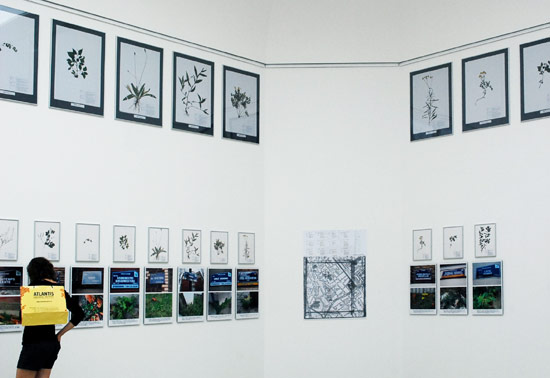
For La Biennale di Venezia, Jef Geys presents an entirely new project. Entitled "Quadra Medicinale", it is an interdisciplinary research project documented with plans, inventories, descriptions, photos and drawings.

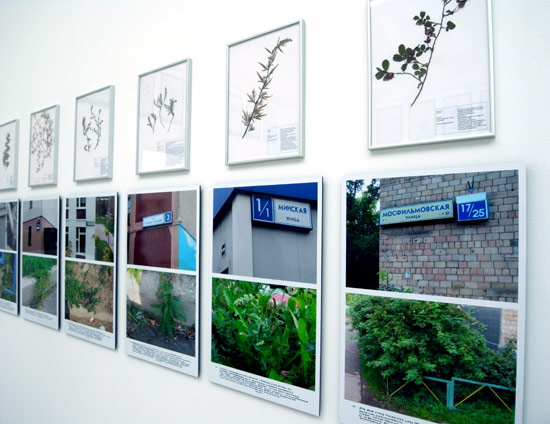
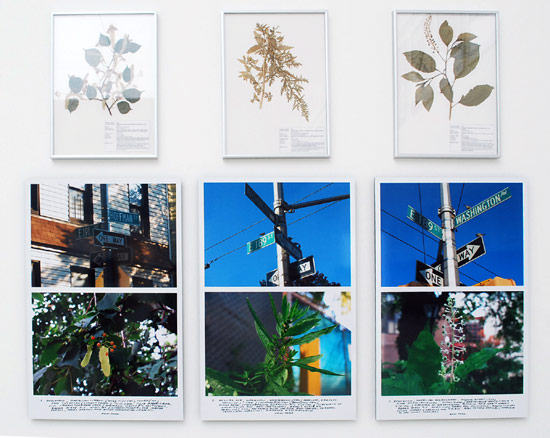
As a point of departure, Jef Geys adopts the term 'terroir', a term that relates more to the notion of biotope than to territory. 'Quadra Medicinale' begins with basic research carried-out by four friends, one per city - Villeurbanne, New York, Moscow and Brussels, on request of the artist. In order to explore the basic elements within their immediate surroundings, each delineated one square kilometre and, within that area, searched for twelve wild plants growing in the streets. The result of this research is an inventory of ordinary plants, so-called 'weeds', which are very often edible or medicinal plants with special properties.

The presentation in the pavilion consists of different designations and scientific descriptions of the plants and their characteristics, a herbarium of dried specimens, and maps of the four cities noting the locations of the plants. The four series are accompanied by the artist's introductory text 'Quadra Medicinale', which appears in some twelve languages, printed in large format, each one annotated with handwritten translations of key words in the artist's development process. Thirdly, Jef Geys presents a series of 50 large drawings, graphical studies of different models; academic figurative studies in addition to plants and weeds, words and names, and pages out of military publications. The entire project is an analysis - by means of natural phenomena that are usually overlooked, an artist's statement complete with graphical renderings - on experience and language, on sources of knowledge as well as on aesthetic delight.

The project is accompanied by a special edition of the "Kempens Informatieblad" (Kempens Information Journal), which gives an overview of 53 of Jef Geys's projects dating from the late-1950s onwards. He documents his long-held interest in the relationships between 'low' forms and complex, 'sophisticated' disciplines such as science and art. In 1971, Geys took charge of the local journal, the Kempens Informatieblad. Since then he has made a special edition for each of his exhibitions. The intention here was to make an edible newspaper in order to test the cradle-to-cradle slogan 'Waste=Food", but the latest developments in printing technology do not yet enable this. The publication is also a guide for every person in need who tries to survive in a metropolis.

Jef Geys (born 1934; Leopoldsburg, BE) has summed up his entire oeuvre as an ongoing project that combines conceptual attitudes, educational activities, and formal experiments. In his practice, Geys affirms a radical independent position and develops an unprecedented approach to collective creativity, frequently generated by the participation of his immediate community. Much of his work has to do with the term 'terroir' (in the sense of biotope), using typical representations of everyday life.
Jef Geys's work has been exhibited worldwide at venues including: "Archive Fever", ICP, New York, USA (2008); "Deep Comedy", Marfa, Texas (2007); Orchard Gallery, New York, NY, USA (2007); IAC, Villeurbanne, France (2007); Pori Art Museum, Pori, Finland; Kunsthalle Lophem, Loppem (2005); Van Abbemuseum, Eindhoven, The Netherlands (2004); Documenta 11, Kassel, Germany (2002); Kunstverein, Munich, Germany (2001); Frac, Champagne-Ardenne, France (1995); Witte de With, Rotterdam, The Netherlands (1993); Palais des Beaux-Arts, Brussels, Belgium (1992); São Paulo Biennial, Brazil (1991).


Maria Thereza Alves, Seeds of Change

Arnolfini, Bristol, 2007

Ballast flora is a category of plants that has become part of the English landscape. It refers to the product of seeds which were brought to this country in the ballast on ships, particularly between the 18th and early 20th century when it was commonly used in mercantile shipping. Ballast generally consisted of sand, stone, earth, pebbles, shells or other cheap materials that came to hand, which was used to balance ships if their cargo was too lightweight. Arriving in port the ballast was unloaded (often clandestinely to avoid taxes), and with it came seeds from all around the world. These ‘ballast seeds’ can sometimes lie dormant for hundreds of years in the mudflats of tidal rivers.
In Bristol, the Brazilian artist, Maria Thereza Alves has researched the sites where ballast would have been off-loaded around the Floating Harbour and along the Avon River, digging up samples of earth in which seeds might lie dormant. With the help of local individuals and groups (many of whom have family links to the port cities Bristol traded with), these ‘ballast seeds’ have been germinated. The resulting array of plants, which have grown up from these small plots of the local terrain, could thus be seen as a living embodiment of the port’s history of trade, reflecting the different routes travelled by Bristol merchants worldwide. Alves says, “Seeds of Change: BRISTOL is an attempt to re-establish the histories of complexities of ballast flora and the potential of individual histories that these plants were witness to, previously isolated from their intimate connection to the economic and social history of Bristol.”
Maria Thereza Alves has also developed a proposal to create a semi-permanent Ballast Garden and the English Landscape Research Institute on Wapping Quay, beside the new Museum of Bristol. 


Maria Thereza Alves (1960, Brazil) lives and works in Berlin. She attended the Cooper Union School of Art in New York and was awarded a DAAD scholarship (Deutscher Akademischer Austauschdients/German Academic Exchange Service) in 2000. She has had shows across Europe and North America and has recently exhibited at: Manifesta 7 (Trentino – Alto Adige), 2008; Greenwashing (Fondazione Sandretto Re Rebaudengo, Turin), 2008; Port City. On Mobility and Exchange (Bristol), 2007; Quanahuac (Kunsthalle, Basel), 2006; Liverpool Biennial, 2004; Rest in Space (Kunstlerhaus Bethanien, Berlin), 2003; Venice Biennial (2001). She was co-founder of the Green Party in Brazil.
Maria Thereza Alves researches social and cultural phenomena; working particularly with situations which question social circumstances about what we think we know and who we think we are instead at where and how we actually are at this time.


http://project.arnolfini.org.uk/cgi-bin/wiki/history.cgi?section=BallastGarden&page=Home&hv=20080218112552 
http://www.amaze.it/eng/?q=node/241